
Open Questions in the Elasticity of Silicone Rubber Pads

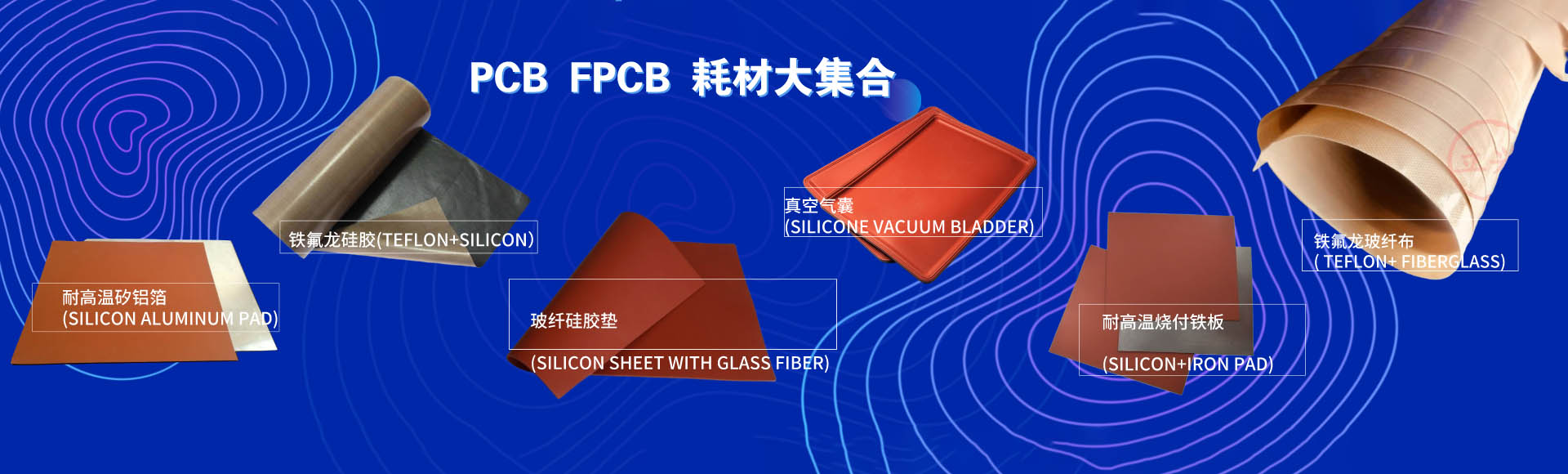
The beige silicone pad and the red silicone pad used in PCB lamination are cushions made of silicone rubber combined with glass fibre. They withstand high temperature and pressure, stay flat, can be reused many times, and are electrically insulating and thermally conductive, which is why they are a common cushion layer in pressing. Even so, the elastic behaviour of rubber still raises a few questions that science has not fully settled, and they explain why real materials cannot be predicted from formulas alone.
The short-chain problem
Rubber is elastic because many polymer chains are cross-linked into a network. In networks made by conventional methods the chains differ in length, and short chains are the majority by number. How this mixture of lengths affects the elasticity of the whole network, especially at large deformation, is still unclear. Short chains clearly depart from Gaussian statistics, so analysing their conformations is difficult, yet a realistic description of the network cannot avoid it.
Network topology
Another open direction is a more detailed account of topology: how many chains meet at each cross-link, how the cross-links are distributed in space, and whether loops form. For uncross-linked polymers the tube model explains chain interactions fairly well, but its application to cross-linked networks remains incomplete.
Stress response of highly filled elastomers
The most pressing issue is the filled elastomer. Once a large amount of filler is added, the material is no longer a true elastic solid. Its stress-strain relation is not reversible, so a strain-energy function is an unsuitable way to describe it, and after stretching and release it shows some degree of anisotropy. Which molecular processes take place during deformation, and which mathematical framework can describe them, are still not known.
What this means in practice
A silicone pad is a filled silicone rubber composite, so its rebound after repeated compression is not perfectly reversible. When choosing a pad, rely on measured behaviour for the thickness, hardness and number of reuses you need. Specifications are on the two product pages above, or contact us.