
Route Conductive Silicone Tubing Through Tight Equipment with Controlled Bend Radius
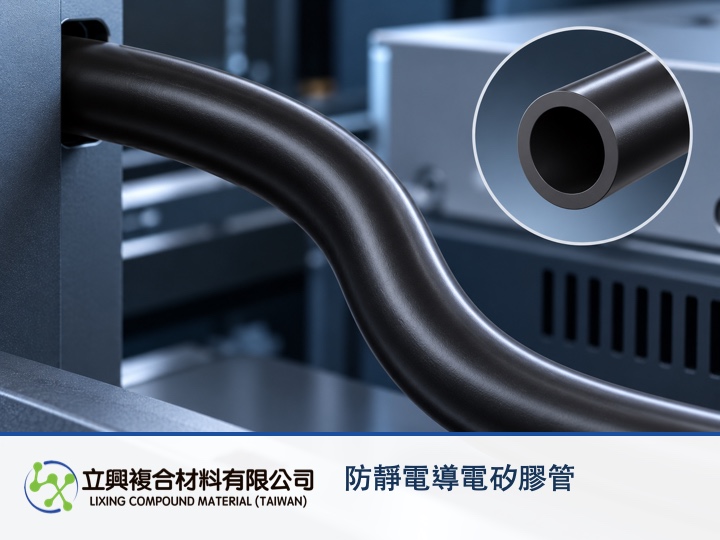
A conductive path inside compact equipment rarely runs in a straight line. Conductive silicone tubing combines a coilable tube form with 70 ± 5 Shore A hardness, helping engineers route around available space while keeping the published 10^6–10^10 Ω resistance range in the ESD design conversation. The practical decision is to coordinate bend radius, tube size, and restraint points.
A flexible tube form preserves room for routing
The official page lists 170% elongation at break and tensile strength of at least 5 MPa. These values support a discussion of bending and tensile allowance, but they are not an allowable bend-radius specification. Their benefit is that mechanical flexibility, support, and routing can be considered alongside electrical requirements.
70 ± 5 Shore A balances support and installation flexibility
Hardness affects how tubing feels and retains its form after turning, contact, and restraint. The conductive silicone tube product page lists 70 ± 5 Shore A, making the product relevant where a route needs support as well as changes in direction. Actual fit still depends on diameter, wall thickness, and restraint method.
Carry the electrical requirement through the route
The catalog decision records an ohmic range of 10^6–10^10 Ω, and the product page identifies ASTM D257. This is a sourcing and verification condition, not a value that can be predicted after bending from beam theory. Verify the completed path under its actual length, contact, and environmental conditions.
Why bend radius deserves design margin
MIT OpenCourseWare presents the beam-geometry relation εx = -y / R, where εx is dimensionless longitudinal strain, y is distance from the neutral axis in metres, and R is the neutral-axis radius of curvature in metres. Under small-deformation pure bending with an approximately plane cross-section, a smaller R means greater outer-fiber strain magnitude. This geometric trend model is not an allowable radius or service-life guarantee for this product. Large deformation, ovalisation, torsion, connector restraint, and repeated flexing require separate validation.
Turn routing choices into verifiable inputs
For sampling or quotation, provide inner and outer diameter, proposed bend radius, route length, restraint locations, operating temperature, contact method, and target resistance condition. For the electrical side of the decision, the existing article on conductive silicone tube resistance control provides the next technical question. Confirm the final choice with samples and the real assembly.
Share the drawing and service conditions with Lixing when flexibility, resistance range, and available equipment space must be assessed together. #ConductiveSilicone #SiliconeTubing #ESD #EquipmentRouting #IndustrialMaterials