
Co-extruded Nickel-Graphite Gasket for Low-Resistance Enclosure Contacts
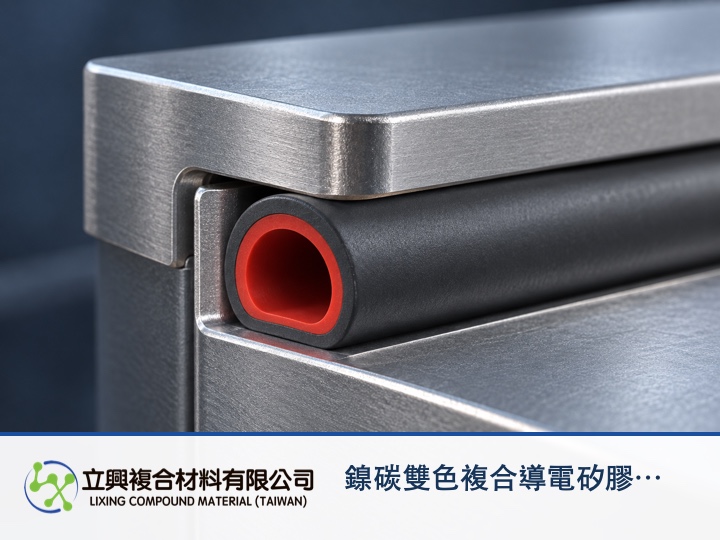
A co-extruded conductive silicone gasket can carry the electrical contact path and environmental seal across an enclosure seam in one profile. For a low-resistance contact decision, engineers should examine outer-layer resistivity, effective contact area after compression and surface cleanliness before choosing the profile and clamping condition. This article uses the verified structure and specifications of the nickel-graphite gasket to frame prototype and acceptance work.
The conductive outer layer supports a continuous seam path
The nickel-graphite outer layer provides the conductive interface. The catalog-approved volume resistivity is ≤0.1 Ω·cm. That value describes the bulk material; installed contact resistance still depends on real contact area, surface films and compression, so material data and enclosure-level measurements should remain separate acceptance records.
The resilient inner layer also serves the environmental seal
A high-resilience non-conductive silicone inner layer conforms at the seam under assembly compression. The product page also states that custom cross-section profiles are available. This combination suits civil telecommunications enclosures, outdoor control cabinets and precision electronic housings that need conductive contact and moisture sealing in one part.
The operating range sets a clear environmental boundary
The catalog-approved continuous operating range is -55 to 160°C, and shielding effectiveness is listed up to 100 dB. Shielding varies with frequency, seam geometry and assembly. Procurement and engineering teams can use the product material and temperature data for candidate screening, then verify contact resistance and shielding on the actual enclosure.
A contact model explains why real area matters
The idealized Holm model for one circular contact spot is Rc = ρ/(2a). Rc is total constriction resistance in Ω, ρ is contact-material resistivity in Ω·m, and a is the radius of the circular real contact spot in m. At fixed resistivity, increasing the effective spot radius reduces ideal constriction resistance. The peer-reviewed model and assumptions require a clean, identical-material, single circular contact; films, multiple rough spots and silicone viscoelasticity are excluded, so the equation is not a product contact-resistance specification.
Validate low resistance and sealing in the same prototype
Provide seam dimensions, available compression, mating metal, operating temperature and target frequency when discussing a profile. Production acceptance should keep clamping and surface treatment fixed while recording contact resistance, seal condition and post-compression appearance. Contact Lixing Composite Materials Co., Ltd. for profile samples or specification review.
#NickelGraphiteGasket #ConductiveSilicone #ContactResistance #EMIShielding #EnclosureSealing