
CPU/GPU Thermal Grease: Set a Thermal-Resistance Budget Before Validation
CPU and GPU cooling selection becomes more useful when processor power and allowable temperature rise are converted into a thermal-resistance budget before a grease grade is chosen. Thermal engineers and buyers can then compare samples under the same heat sink, contact area, mounting condition and load. Lixing’s thermal grease grades and published specifications provide a starting point for that validation.
Give the interface a temperature-rise budget
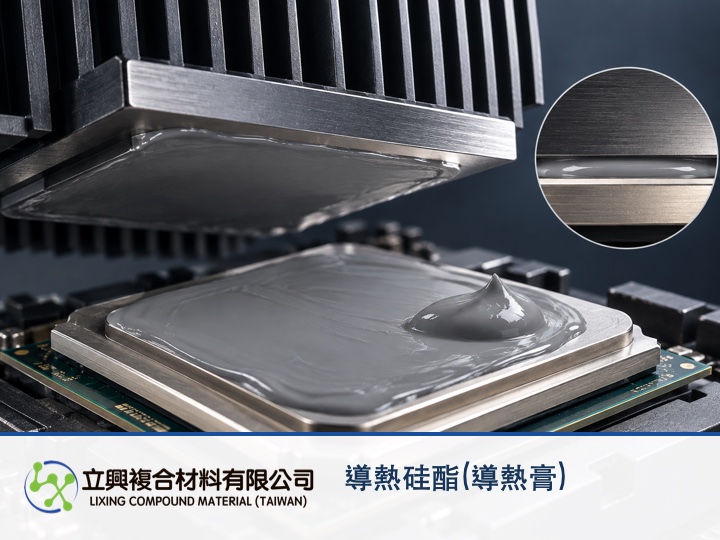
Thermal grease fills small surface gaps between a processor lid and heat sink, reducing the share of the path occupied by air. The product page identifies a grey silicone-based paste, thermal-conductivity grades from 2 to 10 W/m·K, and CPU, GPU and high-power server chips as applications. These are product options; system temperature still depends on bond-line thickness, contact area, pressure and the rest of the cooling path.
Engineering equation: Rθ = ΔT / P
A first thermal budget can use Rθ = ΔT / P. Rθ is thermal resistance in °C/W, ΔT is the temperature difference between defined points in °C, and P is heat flow in W. The relationship is useful for an approximately steady state with defined boundaries; CUI Devices’ heat-sink selection note uses the same temperature-rise and power relationship. A measured system Rθ includes the package, thermal grease, heat sink and ambient path, so it is not a thermal-grease specification by itself.
Validate three benefits under the same conditions
A thin gap-filling layer makes the interface comparable
Gap filling thermal grease conforms to surface texture where a CPU or GPU package meets a heat sink without a large mechanical gap. Fixing dispense quantity, spread area and mounting method makes sample comparisons more meaningful.
Grades from 2 to 10 W/m·K support budget-based screening
The product page lists 2 to 10 W/m·K and cites ASTM D5470. Request the data for the exact grade and confirm test thickness, pressure, temperature and contact surfaces before using conductivity in a system estimate.
A non-flowing state supports interface placement
The product page describes the viscosity state as non-flowing, which suits assemblies where the paste needs to remain at the processor interface. This description is not a service-life guarantee. Sample validation should still inspect pump-out, edge overflow, coverage after disassembly and interface condition after the intended temperature cycle.
Read a CPU/GPU sample result in context
Record actual power, ambient or cold-plate temperature, and processor temperature before calculating the baseline Rθ = ΔT/P. Keep the heat sink, airflow, mounting torque, measurement points and load procedure constant when changing grease grades. If temperature remains above the target, separate excess bond-line thickness, incomplete coverage, heat-sink flatness and other thermal resistances instead of assigning every loss to the material.
Confirm the grade and sample conditions
Lixing publishes an operating range of -40 to 250°C and volume resistivity of 10^14 Ω·cm for the product family. Read these values with the exact grade, test method and assembly conditions. For a CPU, GPU or power-module sample, use the thermal grease product page to request specifications or samples, and provide power, contact area, heat-sink format, planned bond line and temperature target.
#ThermalGrease #CPUCooling #GPUCooling #ThermalResistance #ThermalInterface