
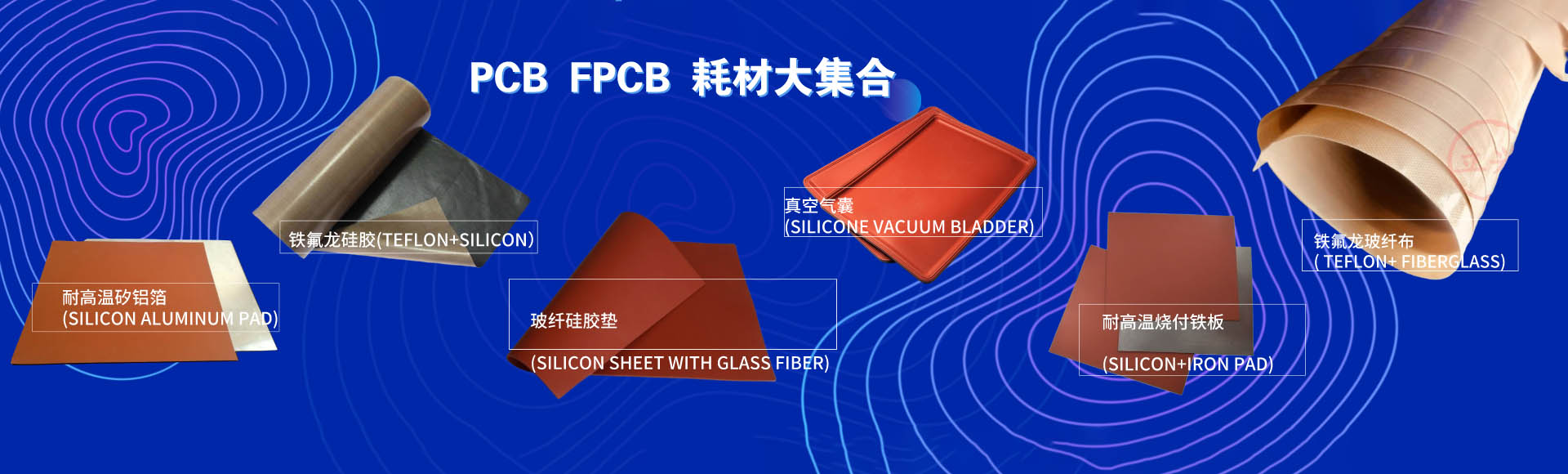
FPC Red Silicone Pad: Heat-Resistant Cushioning for Hot Press Lamination
For stable contact through a high-temperature FPC press cycle, check three inputs first: whether the recipe stays within the recommended 160°C to 250°C operating range, whether 50 HA ±5 hardness suits the pressure-transfer need, and whether the pad can lie flat against the hot plate. The FPC Red Cushing Pad combines brick-red silicone with glass fiber for lamination processes that need heat distribution and cushioning together.
Deliver heat and pressure to the working contact area
The red silicone pad serves as a cushioning layer on a hot press. Its compliant surface helps maintain contact across circuit topography while the press transfers heat and pressure. The product page lists temperature resistance up to 250°C and a recommended operating range of 160°C to 250°C. These values start the selection discussion; pressure, dwell time, workpiece thickness and machine temperature variation still belong in the actual trial.
Fiberglass reinforcement supports a flexible pad
The product consists of silicone and glass fiber and carries a listed hardness of 50 HA ±5. Silicone supplies conformity and cushioning, while one central glass-fiber cloth layer supports the composite structure. Available evidence does not justify depicting a multilayer rigid laminate or claiming a fixed compression percentage.
Read temperature together with dwell time
Temperature accelerates many material-degradation mechanisms. NIST presents the Arrhenius relationship as k = A × exp(-Ea / (R × T)), where k is the rate constant for a selected mechanism, A is the pre-exponential factor, Ea is activation energy in J/mol, R is 8.314 J/(mol·K), and T is absolute temperature in K. The model requires a relevant dominant mechanism and fitted test parameters. It cannot predict this pad's life or reuse count without product-specific aging evidence. Read the NIST Arrhenius model reference.
Flat contact helps control local hot spots
The product page recommends a flat, scratch-free hot-plate surface and close contact between the pad and heating surface. A first-article check can inspect warpage, sharp folds and surface damage after heating, dwell and cooling. Lixing also supports cutting and customized dimensions, subject to the required process conditions.
Turn published values into a trial condition
Engineering and purchasing teams can define a sample by operating temperature, hardness and dimensions, then verify it with the actual plate, workpiece and press time. Review the red silicone pad data and request a sample so the material and press recipe are evaluated together.
#FPCLamination #RedSiliconePad #HeatResistance #Fiberglass