
4W Thermal Gel Across Temperature: Read Bondline and Contact Resistance Together
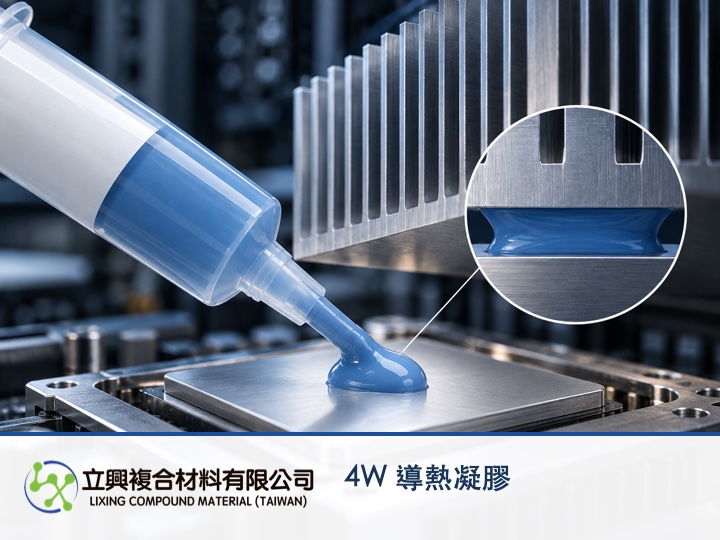
4W Thermal Gel lists an operating range of -30 to 180°C, giving engineers one blue, single-component material to consider across cold start, normal operation, and elevated-temperature conditions. Validation still needs the mean test temperature, bondline thickness, and both contact resistances recorded together so the interface can be judged in the actual assembly.
A wide operating range simplifies the material shortlist
The published operating range is -30 to 180°C. It supports evaluation in civilian electronics that move between low-temperature start-up and hot operation, while the final assembly still requires temperature cycling, surface, and service-duration checks.
4.0 W/m·K gives the thermal model a defined starting point
The product page lists thermal conductivity at 4.0 ± 0.2 W/m·K. Engineers can use this value for an initial material-layer model, then measure the assembled interface. The thermal gel gap-filling article adds context on contact and surface gaps without replacing assembly validation.
Dispensable gel follows irregular interface geometry
This blue, single-component gel lists a viscosity of 6,500,000 ± 5% mPa·s and cone penetration of 170 ± 10 in 0.1 mm units. It suits dispensing into geometric gaps and rough interfaces between a heat source and cooling module; the fixture and sample must still establish the delivered volume and final bondline thickness.
Low oil separation and volatility support longer observations
The product page lists oil separation at ≤ 0.01% and volatile content at ≤ 0.8%. These specifications can be included in post-ageing appearance and mass checks, but they do not translate directly into a lifetime claim for a specific device.
Use the ASTM D5470 relation to read thermal impedance
The engineering relation is θ = BLT / k_app + θ_c1 + θ_c2. Here, θ is total area thermal resistance in m²·K/W; BLT is bondline thickness in m; k_app is apparent thermal conductivity in W/(m·K); and θ_c1 plus θ_c2 are the two area contact resistances in m²·K/W. ASTM D5470 specifies steady-state, approximately one-dimensional parallel heat flow and an average specimen temperature. Results at different temperatures are comparable only when thickness, pressure, and interface conditions remain comparable. The equation is an engineering model, not a product guarantee in every assembly.
Build low, normal, and high temperature points into one record
The published applications include 5G communications, automotive electronic control units, servers, LED modules, and power supplies. A sample plan can hold the dispensing path and assembly condition constant, record steady temperature difference and heat flow at selected operating points, and compare θ. This keeps the material operating range separate from the assembly-specific interface result.
Send real interface conditions with the sample request
Provide the operating-temperature range, gap distribution, surface materials, expected dispense volume, and assembly pressure. Review the 4W Thermal Gel specifications, then confirm packaging, equipment compatibility, and sample arrangements with Lixing.
#4WThermalGel #ThermalInterfaceMaterial #ASTMD5470 #ThermalResistance