
Copper Foil Self-Adhesive Tape Holds Die-Cut Dimensions Under Web Tension
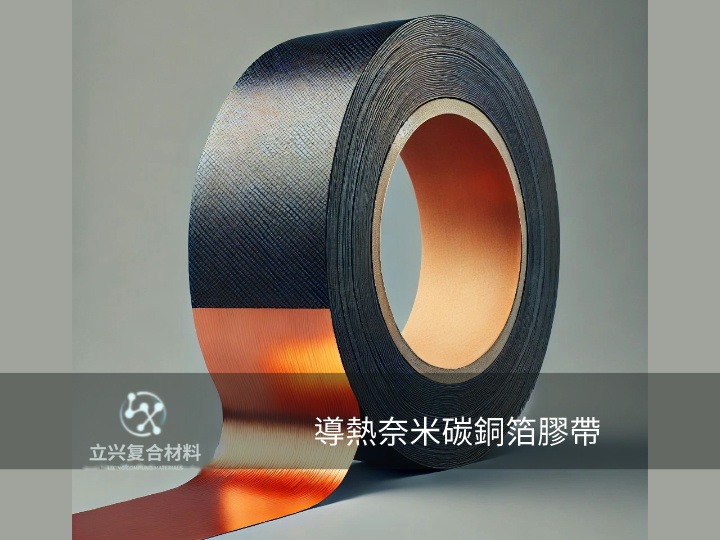
Copper Foil Self-Adhesive Single-Sided Tape suits small die-cut parts that spread heat and shield EMI inside phones and tablets. Lixing lists good mechanical strength and dimensional stability through die-cutting and lamination, with substrate thickness from 0.009 to 0.07 mm. To keep parts true to the drawing, choose the substrate thickness against your tolerance, then request samples with the drawing in hand.
A copper substrate resists web tension, so parts stay closer to the drawing
Die-cutting and lamination both pull the web forward, and whatever the web stretches under tension it gives back after the cut. This tape uses high-conductivity copper as its substrate with a nano-carbon surface layer. Lixing lists dimensional stability as a product highlight: its mechanical handling characteristics improve efficiency during die-cutting and lamination. For narrow-edge or multi-hole heat spreader parts, a substrate that resists stretching removes one source of dimension drift.
Substrate thickness from 0.009 to 0.07 mm to match your tolerance
The product page lists substrate thickness of 0.009 to 0.07 mm and total thickness of 0.03 ± 0.005 to 0.155 mm. Thin grades fit positions where stack height is tight; thicker grades stretch less at the same tension and suit parts with tighter tolerances. Our earlier article on saving space in thin electronic assemblies covers how thickness frees up room; this one adds how thickness affects die-cut dimensions.
Acrylic adhesive tacks the part in place before final pressure
The single adhesive side is acrylic, black or transparent light yellow. Published values are 180° peel strength on stainless steel of ≥ 1.0 to ≥ 1.50 N/25mm, initial tack of ball No. ≥ 2, and holding power of 8 to 12 hours (1 inch) at room temperature. Initial tack holds the part where you place it, then 2-3 kg of pressure removes trapped air. It bonds well to metal surfaces such as stainless steel and aluminum.
One die-cut part handles heat spreading and EMI shielding
The product page lists base thermal conductivity of 400 W/m·K and composite thermal conductivity of 600~800 W/m·K, together with EMI shielding and UV resistance. A single die-cut piece of copper foil can carry both jobs. For shielding continuity, see our article on copper foil tape for thin EMI shielding.
Where it is used
Lixing lists thin-profile thermal management for smartphones, tablets and precision electronic devices. In these products a heat spreader is usually a shaped part die-cut to the mechanical drawing and bonded to stainless steel or aluminum. A dimensionally stable substrate keeps one batch of parts more consistent and makes fixture alignment easier to set up.
Why a thicker substrate holds die-cut dimensions better
The stretch of a web under tension can be estimated with Hooke's law: ε = ΔL / L0 = F / (E × w × t). The relation follows OpenStax University Physics Volume 1, Section 12.3. It is an engineering model, not a specification of this product.
- ε: tensile strain, dimensionless (ΔL / L0)
- ΔL: elongation under tension, mm
- L0: original length, mm
- F: tension along the web, N
- E: Young's modulus of the material, Pa (N/m²)
- w: web width, m
- t: thickness of the load-bearing substrate, m; w × t is the cross-section A
Applied to this product's thickness range, and treating the copper substrate as the only load path, a 0.009 mm substrate stretches about 7.8 times as much as a 0.07 mm substrate at the same tension and width (0.07 ÷ 0.009). The model holds while stress stays below the proportional limit and the material is linearly elastic. It ignores adhesive creep, temperature, humidity and die wear in what is really a copper, nano-carbon, acrylic and liner composite. The product page publishes no Young's modulus, so use the result for relative comparison only and confirm actual stretch and die-cut tolerance by measuring samples.
What to send with a sample request
- The part drawing and dimensional tolerance, marking small holes and narrow edges
- Required substrate and total thickness, and black or white color
- The mating surface; rubber or resin surfaces need a primer first
- Lamination conditions; preheat the surface below 15°C and apply 2-3 kg pressure
Unopened packaging keeps for 12 months at 10-25°C and 30-70% RH, which helps with material planning.
Request samples with your drawing
Send the drawing, tolerance and lamination method to yw@zh-lx.com, or review the full specification on the Copper Foil Self-Adhesive Single-Sided Tape product page first. Lixing can discuss sample specifications by thickness and color.
#DieCutting #CopperFoilTape #ThermalMaterials #ElectronicsCooling #EMIShielding