
Aluminum Foil Silicone Sheet Gap Filling: Firmer FPC Bonding Over Uneven Circuit Traces
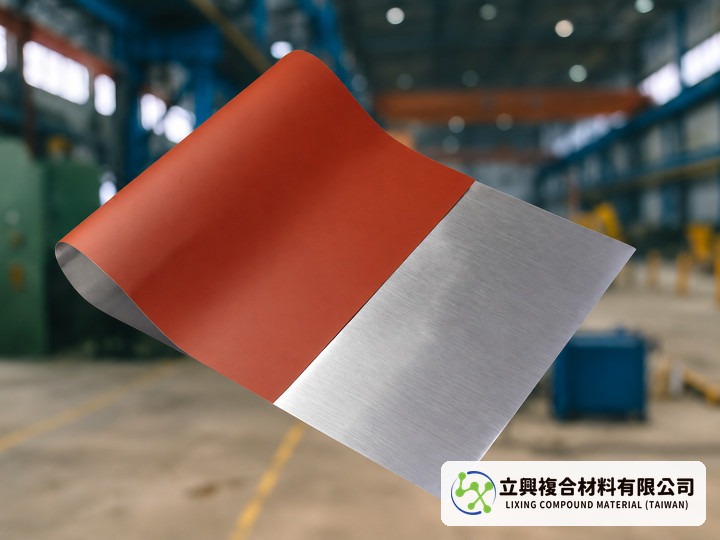
The silicone layer of an aluminum foil silicone sheet wraps the height steps of circuit traces during FPC hot pressing, so the recesses still receive pressure, adhesive fills more completely and interlayer FPC bonding holds firmer. Buyers and process engineers can start with three specifications: silicone hardness of 55 ± 5 Shore A, thickness of 0.4 to 0.6 mm and operating pressure of 80 to 150 kgf/cm², then request samples for a trial press on their own stack-up.
Uneven Traces Let the High Spots Take the Pressure
In FPC hot press lamination, copper traces stand above the base film. A hard cushion touches only the tops of the traces, so the recesses between them see too little pressure and the adhesive cannot flow in. Voids or weak interlayer bonding can follow. Engineers choosing FPC materials raise this question often.
Four Benefits of the Aluminum Foil Silicone Sheet
Pressure Reaches the Recesses for Fuller Filling
The silicone layer deforms around the trace profile and carries pressure into the gaps. The Lixing product page states that this silicone layer offers excellent gap-filling properties, giving better product molding and stronger interlaminar bonding during the thermal press cycle.
Aluminum Foil Keeps the Plane Flat
A soft pad on its own can rise and sink with the load. Here the aluminum foil substrate provides rigid support, and the product page states that the sheet stays flat under 80 to 150 kgf/cm². The silicone handles the steps while the foil holds the plane.
More Even Temperature Across the Panel
Installed on the hot plate, the sheet gives a more even temperature distribution. Adhesive flow depends on temperature, so closer temperatures across the panel help the filling stay consistent.
Heat Resistance and Life for Repeated Pressing
The product page rates it above 280°C with a recommended 160°C to 250°C for long-term use, and a typical service life of about 6,000 to 8,000 cycles depending on parameters, which lowers replacement cost. For pad change planning, see aluminum foil silicone sheet service life in FPC press cycles; for how the foil keeps the sheet flat, see flatness control with an aluminum-foil silicone sheet.
Where It Is Used
The product page lists hot press lamination of FPC and battery conductive lines, with the sheet mounted on the hot plate as a cushion layer. Batches with pronounced trace steps and strict interlayer bonding needs are where the filling benefit shows.
Why It Works: Compressive Stress and Step Height
A compressive stress-strain relation based on Young's modulus explains the trend (an engineering model; source: OpenStax University Physics 12.3 Stress, Strain, and Elastic Modulus):
Δσ = E × (Δh / t)
Δσ is the extra compressive stress on a raised feature relative to a recess (MPa); E is the elastic modulus of the silicone layer in compression (MPa); Δh is the local height difference the silicone must absorb (mm); t is the silicone layer thickness (mm), and Δh / t is the local compressive strain. With a lower modulus and enough thickness relative to the step, the high spots take less extra load and the recesses keep more pressure to push adhesive into gaps.
The relation is a small-strain, linear-elastic estimate for comparing trends. Silicone is nearly incompressible, so a thin layer clamped top and bottom has a higher effective modulus that depends on its shape factor, and the modulus shifts at press temperature. The model leaves out adhesive flow and time. It cannot predict fill depth, yield or service life and is not a product specification; the product page does not list a modulus value.
What to Prepare Before an Inquiry
- Trace step height and stack-up, which set how much the silicone must absorb.
- Process temperature and pressure, compared with the recommended 160°C to 250°C and 80 to 150 kgf/cm².
- Thickness and color: 0.4 to 0.6 mm, in vermilion or black.
- Silicone oil migration: the product page recommends covering the silicone surface with fiberglass cloth during operation.
- Mounting surface: the hot plate must be flat and free of scratches, with the sheet laid flat against it to avoid air gaps.
Request Samples or a Specification Review
Send us your trace step height, stack-up, temperature and pressure, and Lixing can supply aluminum foil silicone sheet samples for a trial press. Email: yw@zh-lx.com; Taiwan mobile +886 905 198 368; mainland China mobile +86 139 2690 8508; LINE / WeChat: jerryhuang.
#AluminumFoilSiliconeSheet #FPCLamination #HotPress #CushionPad #FPCBonding