
Transparent PET Tape That Peels Off Clean at Fast or Slow Peel Speeds
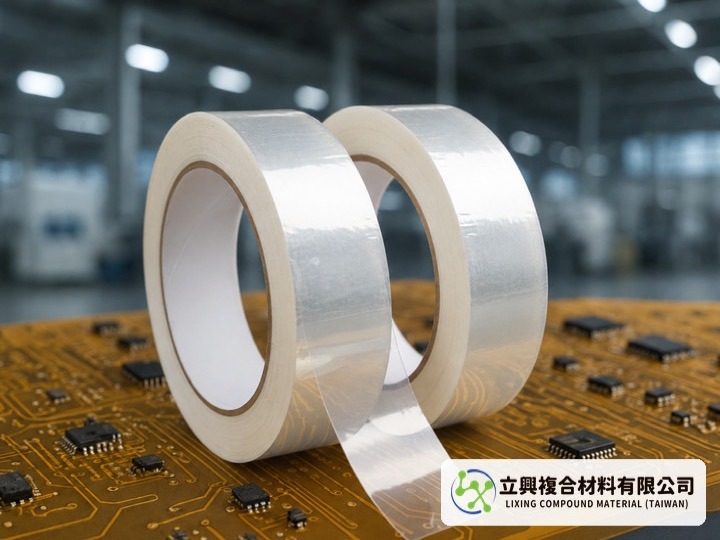
If protective tape has to come off cleanly after hot pressing or assembly, Transparent PET Tape gives you three figures you can check directly: the product page records a pass on fast-peel and slow-peel adhesion tests, a peel strength specification of 600 – 700 g with a tested result of 650 g, and a 180°C heat rating. Before rollout, apply a short strip to your own substrate, run it through your process temperature and removal method, and confirm the surface is clean.
Clean removal saves a cleaning step
Residue left on parts or fixtures adds a wiping or solvent step downstream and can disturb the next bond. This industrial tape combines a PET film backing with a pressure-sensitive adhesive, and the product page states it leaves no adhesive failure or residue whether peeled quickly or slowly. The adhesion test row in the specification table, “no adhesive failure on fast or slow peel”, is marked as a pass.
650 g peel strength: holds in process, releases on demand
Too little peel strength and edges lift mid-process. Too much and removal can stress the substrate or leave adhesive behind. The product page sets peel strength at 600 – 700 g with a tested result of 650 g, near the middle of the range. The page does not state the test width, angle or substrate, so align test conditions before comparing it with another tape.
Ball No. 18 initial tack for quick positioning
Stations that fix parts quickly need tape that grips on contact. The product page lists an initial tack standard of ball No. 14 or higher, with a tested result of 18.
Still easy to finish after 180°C processing
Tape used for lamination protection has usually been heated once before it is removed. The product page rates it to 180°C and describes stable adhesion at that temperature without becoming brittle or shrinking. For more on heat resistance and lamination protection, see our article on heat-resistant transparent PET tape for thin, visible lamination protection.
A 50 μm clear film you can see through before you peel
Total thickness is 50 ± 2 μm, made of a 0.038 mm PET backing and a 0.012 mm adhesive layer. The clear backing lets operators see part positions through the tape, so placement and anything unusual underneath can be checked by eye before removal.
Where it fits
- Precision electronic component fixing: the clear backing helps alignment and inspection.
- Lamination process protection: rated to 180°C and removed after the cycle.
- High-quality packaging: listed on the product page as an intended use.
Clean or not depends on where the separation happens
When tape is peeled, separation can occur inside the adhesive layer, known as cohesive failure, which splits the adhesive and leaves part of it on the surface. It can also occur between the adhesive and the substrate, known as interfacial failure. A 2015 Soft Matter study of pressure-sensitive adhesive peeling by Villey and co-authors notes that interfacial failure leaves the substrate clean and is the most typical and useful failure mode for PSAs.
The same study measured a strong dependence of adherence energy on peel velocity, so one roll can behave differently under fast and slow peeling. The fast-peel and slow-peel tests on the product page address exactly that variable.
Engineering formula: how peel angle changes removal energy
The study expresses the peeling energy balance using fracture mechanics:
G = F × (1 - cos θ) / b
- G: peel energy release rate, the work needed to peel one square metre, J/m².
- F: peel force, N.
- θ: peel angle between the lifted tape and the substrate.
- b: tape width, m.
At a 180° fold-back peel, cos θ equals -1 and G equals 2F divided by b; at 90°, G equals F divided by b. With the same pull, a 180° peel delivers twice the energy to the peel front compared with 90°, so a change in removal method on the line can change residue behaviour too.
Conditions and limits: the relation assumes steady peeling with negligible backing stretch, and the source states elastic energy in the backing is negligible for peel angles above about 20°. It does not include temperature or speed effects and cannot predict residue on its own. The product page does not give the width or angle of its peel test, so 650 g cannot be converted into a G value; the formula explains the principle and is not a product specification or guarantee.
What to prepare before requesting a sample
- Substrate: metal, glass or plastic surface, since interfacial adhesion differs by material.
- Process temperature and time: how close the peak gets to 180°C and how long it is held.
- Removal method: manual or machine, peel angle and speed, and whether removal waits until parts cool.
The specification table lists the master roll size as 1050mm x 33m x 0.05mm. Check the full specifications on the Transparent PET Tape product page, or email yw@zh-lx.com to request a sample and run a peel trial on your own material.
#TransparentPETTape #CleanRemoval #FPCLamination #IndustrialTape