
Custom-Thickness Conductive Cloth Tape for Tight EMI Grounding Paths
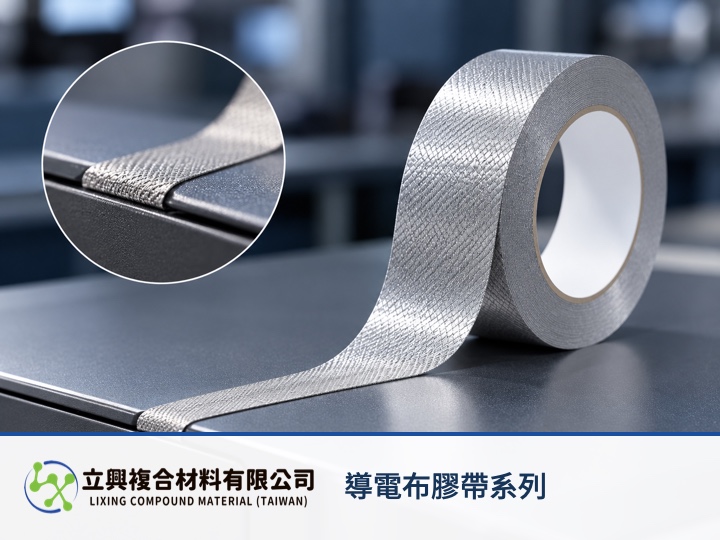
When an enclosure seam, PCB ground point or cable wrap leaves little clearance, LX-DDB conductive cloth tape can be ordered with a customized total thickness so engineers can consider the gap, bend and grounding overlap together. The official product data identifies a composite roll made from 260T plain-weave conductive fabric and conductive acrylic adhesive, suited to designs that need flexible contact in compact EMI grounding layouts.
Thickness can follow the available clearance
Custom total thickness lets a prototype reflect the actual enclosure instead of forcing one stock construction into every assembly. The LX-DDB conductive cloth tape product page lists total thickness as customizable but does not publish a fixed menu. A sample request should therefore state available clearance, tape width and bend radius.
A soft fabric carrier follows bent routes
The 260T plain-weave conductive fabric can bend and wrap around enclosure edges, PCB overlaps and cables. The product page also supports custom die-cut shapes, allowing width and outline to be discussed with thickness instead of adding unnecessary overlaps to route around nearby features.
Verified electrical and adhesion data support comparison
Electrical and bonding conditions still need verification after a thickness is selected. The official page lists surface resistance of ≤ 100 mΩ, 180-degree peel strength of ≥ 1.3 kgf/in and short-term temperature resistance of 120°C. These are published product conditions; they do not establish identical performance for every custom thickness, surface, pressure or frequency.
A geometry model explains the thickness boundary
R = ρL / (w t) is a uniform-conductor engineering model, where R is resistance, ρ is resistivity, L is path length, w is width and t is uniform effective thickness. The OpenStax resistivity and resistance reference gives R = ρL/A, which becomes the stated form when A = wt. LX-DDB is a conductive-fabric and adhesive composite, so actual grounding impedance also depends on anisotropy, adhesive, contact pressure, overlap and frequency. The formula explains geometry only and is not a product guarantee.
Put the custom conditions in the sample request
Provide available total thickness, tape width, path length, minimum bend radius, adherend and operating temperature, then verify resistance and peel conditions on the assembled sample. Use the official specification page to request samples or technical consultation; the site does not offer online checkout.
#ConductiveClothTape #EMIShielding #CustomThickness #PCBGrounding