
LXFP-256 Silicone Foam Gasket: Plan Compression Margin Across Temperature
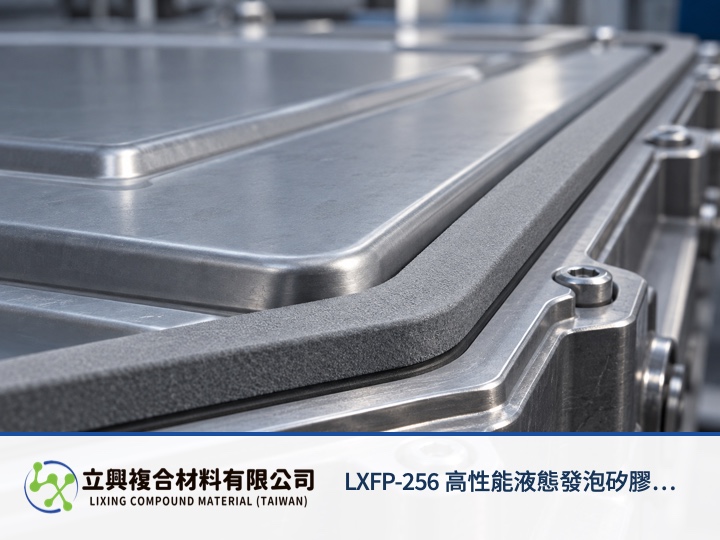
LXFP-256 Liquid Silicone Foam Elastomer gives battery-pack and transportation-electronics designers a choice of hardness and thickness for sealing across a broad temperature range. Start with the real minimum and maximum temperatures and joint length, then check hardness, thickness, and compression margin. The product page recommends continuous service from -55°C to 200°C, while the assembled enclosure still requires validation under its flange, preload, and thermal-cycle conditions.
Three practical benefits for wide-temperature sealing
A broad stated service range supports early material screening. The official page lists -55°C to 200°C for continuous service, covering the cold-start and hot-operation conditions considered in civilian battery enclosures. This range is a material selection input, not proof that every enclosure remains sealed at every temperature.
Two hardness grades separate support from conformability. HD50 is 50 ± 5 Shore C with a standard 2 ± 0.2 mm thickness. SD25 is 25 ± 5 Shore C and is available from 0.6 to 12.7 mm. Prototype selection can therefore follow joint stiffness, groove depth, and target compression.
Roll stock and conversion support custom flange geometry. Lixing supplies multiple thicknesses and can convert material to specified dimensions. Provide the joint width, corners, openings, and intended compression when requesting samples.
Translate temperature swing into a dimensional question
The linear thermal-expansion approximation is ΔL = α × L0 × ΔT. ΔL is length change, α is the coefficient of linear expansion, L0 is initial length, and ΔT is temperature change. The OpenStax thermal-expansion chapter explains its use when α can be treated as approximately constant over the interval. The LXFP-256 page does not publish α, so no product displacement is calculated here. Obtain the relevant material data and validate the gasket together with the enclosure and fasteners.
Four verified selection inputs
- Recommended continuous service: -55°C to 200°C.
- HD50: black, 50 ± 5 Shore C, standard thickness 2 ± 0.2 mm.
- SD25: white, gray, black, or red, 25 ± 5 Shore C, thickness 0.6 to 12.7 mm.
- The product page lists UL 94 V-0, low water absorption, and battery-pack sealing, vibration damping, and thermal-insulation applications.
Confirm the boundary with an assembly prototype
Record joint dimensions at the minimum and maximum temperatures, initial gasket thickness and target compression, flange stiffness, and preload method. Then evaluate airtightness or water ingress after thermal cycling. Product-page values support screening; they do not replace assembly testing.
Review the LXFP-256 Liquid Silicone Foam Elastomer product page for both grades and available thicknesses. For a related discussion, see silicone foam compression and sealing mechanics. Send the joint geometry, operating temperatures, and intended compression to Lixing for sample and specification consultation.
#SiliconeFoam #SealingGasket #BatteryPack #TemperatureResistance