
Polyimide Gold Finger Tape for Cleaner Chemical Masking Boundaries
Polyimide gold finger tape creates a clear masking boundary during PCB plating, painting and bake-coating, helping keep process chemicals and coatings away from protected contact areas. A useful selection review covers the chemical, concentration, process temperature, exposure time and removal condition so the product page's acid, alkali and solvent resistance is applied within a verified process window.
Amber film makes the masking boundary visible
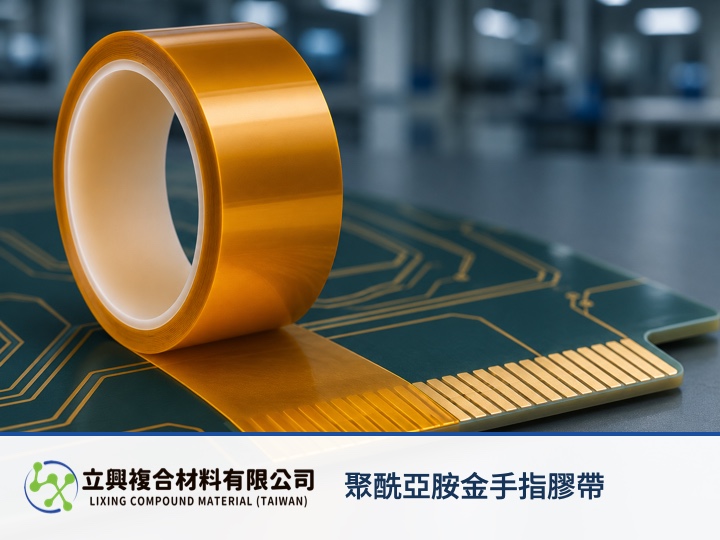
The thin, semi-transparent amber roll helps operators see placement and edge alignment. YD-08-YL Polyimide Gold Finger Tape uses a polyimide film with a high-temperature silicone pressure-sensitive adhesive. Its official page describes a smooth surface and applications in PCB process masking, plating and painting.
Resistance to acids, alkalis and solvents supports process masking
The official product page lists resistance to acids, alkalis, solvents and process chemicals. This supports short-duration masking applications, but it does not establish one universal service life for every chemistry. Compatibility still depends on formulation, concentration, temperature and contact time.
A thin construction helps define the protected edge
The catalog ruling identifies a total thickness of 0.065 mm, while the product page gives 0.065 ± 0.005 mm. A thin tape can reduce the pronounced step associated with thicker masking materials. Surface cleanliness and firm edge contact still affect whether liquid enters from the boundary.
The same masking concept can extend to heated operations
The product page lists 260°C / 30 min temperature resistance and describes removal after high-temperature painting and bake-coating. That value belongs to a stated test condition. It is not a guarantee for arbitrary chemical exposure or duration, so production validation should use the actual substrate and thermal profile.
Fick's first law explains the role of a concentration gradient
Diffusive transport can be represented by Fick's first law: J = -D(dC/dx). J is diffusive flux, D is the diffusion coefficient, C is concentration and x is distance through the material. NIST's diffusion reference describes migration from higher to lower concentration. This one-dimensional steady-state model does not capture edge ingress, interfacial contact or adhesive compatibility, so it cannot predict this tape's chemical service life.
Bring the real process conditions into sample evaluation
For a sample review, provide the substrate, chemical and concentration, temperature, contact time, masking width and removal timing. After checking the gold finger tape specifications, test edge ingress and residue under the actual process. Lixing can support specification discussion and sample requests.
#PolyimideTape #GoldFingerTape #PCBMasking #PlatingProcess