
Selecting Thermal Silicone Cloth Thickness for Interface Fit
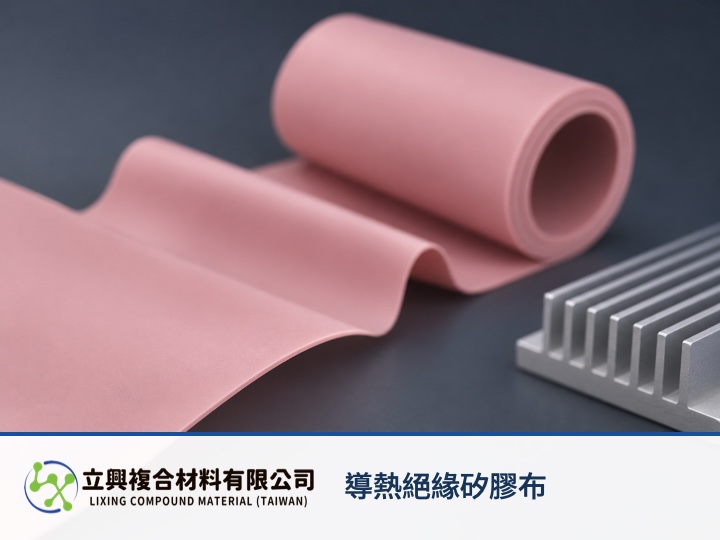
Thermal conductive silicone cloth can be specified from 0.2 to 1.0 mm thick. Engineers can narrow the sample range with the assembly gap, insulation requirement, and heat-transfer area, then confirm contact in the actual module. This gives thickness customization a practical basis without treating one conductivity value as the answer for the complete interface.
A thin-sheet range gives interface designers room to adjust
The official thermal conductive silicone cloth page lists a 0.2–1.0 mm thickness range and customization of width, length, and thickness. The roll material can be cut to a module profile where a thin thermal path and electrical isolation are both required.
Thermal and insulation conditions can be reviewed together
The product page states thermal conductivity of 0.8–3.0 W/m·K, withstand voltage above 4 kV, and an operating-temperature range from -30°C to 200°C. Each value describes a separate material condition. Selection still needs thickness, effective contact area, and the real clamping condition; one specification cannot predict system performance.
Fiberglass reinforcement supports roll handling
Official information describes silicone combined with fiberglass and gives tensile strength above 150 Kgf/cm². That structure is relevant when considering converting and handling of the roll. Final dimensions, tolerances, and the cutting process still need confirmation against the drawing.
Use a resistance model to frame thickness
One-dimensional steady conduction through a plane wall can be written as Rcond = L / (kA). Rcond is conduction resistance in K/W, L is thickness in m, k is conductivity in W/(m·K), and A is effective area in m². The MIT thermal-resistance reference shows that increasing thickness raises the material conduction resistance when material, area, and boundary conditions stay the same. The model assumes steady one-dimensional flow and nearly constant k. It excludes contact resistance, pressure, roughness, edge loss, and anisotropy, so it is an initial comparison rather than a product guarantee.
Send assembly conditions with the sample request
Provide target thickness, sheet dimensions, contact area, operating temperature, withstand-voltage need, and clamping method. Include the gap and surface-height variation when relevant. Review the available product options, then contact Lixing for samples and tolerance confirmation based on the real assembly.
#ThermalMaterials #SiliconeCloth #ThermalManagement #ThicknessSelection