
Selecting Aluminum Thermal Tape: In-Plane Spreading, Bonding, and Insulation Boundaries
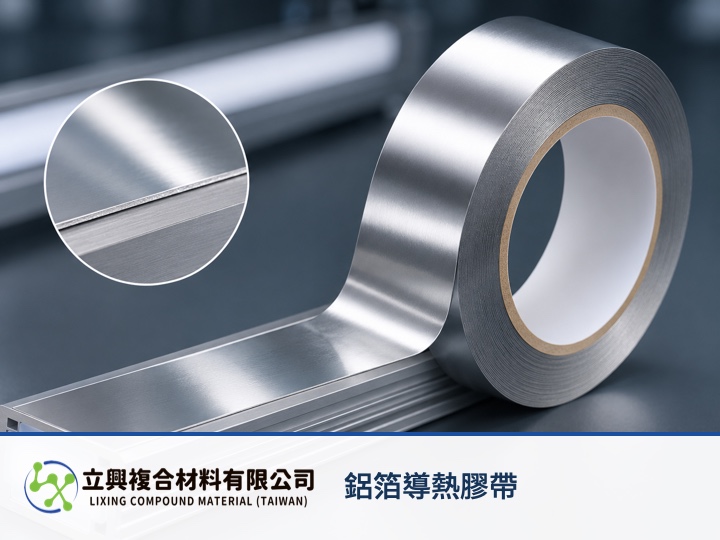
LED and power-conversion assemblies can use aluminum thermal tape to move a local hot spot toward a larger metal surface. Selection starts with heat-flow direction, bonded thickness, and electrical boundaries. The H-TT-AL Aluminum Thermal Conductive Tape page lists 0.100 ± 0.005 mm total thickness, 0.45 W/(m·K) thermal conductivity, and 6 kV dielectric withstand for an initial engineering screen.
The metal face provides an in-plane spreading route
The aluminum face spreads heat along its surface before heat enters a housing or heat sink. H-TT-AL is a silver foil roll with 0.060 ± 0.003 mm face-stock thickness, suited to thin bonding positions in LED lighting and power equipment. Bonded area and system geometry still determine the result.
The adhesive makes thin foil bondable
H-TT-AL has 0.040 ± 0.003 mm adhesive thickness, 0.6 kg/25mm initial loop tack, and 1.5 kg/25mm adhesion to mirror steel. These published values support screening; contamination, roughness, curvature, and bonding temperature require target-surface checks.
Separate aluminum and fiberglass by assembly needs
Choose aluminum when the design needs a metal face and surface heat spreading. For a fiberglass-reinforced candidate, request its substrate, thickness, conductivity, dielectric, and adhesion data before comparison. Fiberglass alone is not a performance claim.
Verify voltage and temperature in the real stack
The official product page lists 6 kV dielectric withstand and -30°C to 150°C operating temperature. The assembly must still account for electrode shape, edge clearance, contamination, voltage, and cycling. Exposed aluminum edges, grounding, and insulation boundaries need review.
Fourier's law explains heat-flow direction
Fourier's law is q = -k∇T. q is heat flux in W/m², k is conductivity in W/(m·K), and ∇T is temperature gradient in K/m. It distinguishes through-thickness conduction from in-plane spreading, but omits contact resistance, voids, pressure, and system geometry.
Put comparable inputs into the sample request
- Heat path: source, bond area, housing, and heat sink.
- Stack: thickness, flatness, bend radius, and cut dimensions.
- Electrical boundary: voltage, foil edge, grounding, and clearance.
- Bonding: substrate, cleaning, temperature, and pressure.
Lighting and power teams can begin with H-TT-AL's verified data when thin bonding and surface spreading matter. Compare fiberglass only after the same inputs are available. Contact Lixing Composite Materials Co., Ltd. for samples and specification support for the actual substrate and heat path.
#AluminumThermalTape #ThermalMaterials #LEDCooling #PowerElectronics #ThermalManagement