
Copper Foil Self-Adhesive Tape vs Graphite Spreaders for Thin Electronics
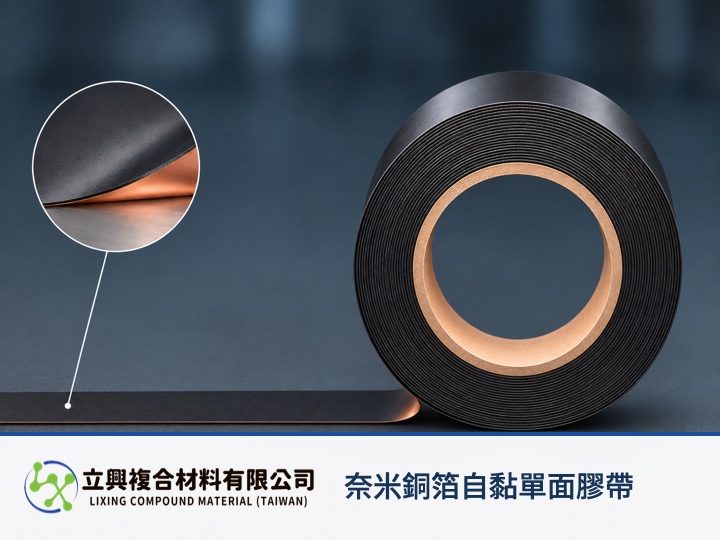
Copper Foil Self-Adhesive Single-Sided Tape suits smartphones, tablets, and precision electronics that need thin heat spreading, stable die cutting, and repeatable placement. Teams evaluating copper foil tape for electronic manufacturing should start with heat-flow direction, available thickness, interface bonding, and EMI grounding before comparing it with a graphite spreader. When a part must be die cut and fixed with its own adhesive, this product offers a copper base, acrylic adhesive, and dimensional stability in one construction.
A copper composite provides a continuous path away from a hotspot
The product uses a copper base with a nano-carbon composite surface. Its published composite thermal conductivity is 600 to 800 W/m·K, while the base value is 400 W/m·K. These catalog values can guide sample selection. They do not equal an assembled-device temperature reduction, and they do not establish a percentage advantage over graphite without a controlled comparison.
Self-adhesion combines the spreader and bonding step
The acrylic adhesive is specified for surfaces including stainless steel and aluminum. The product instructions call for a clean, dry surface and applied pressure to remove trapped air. This can reduce the need for a separate fixing layer in thin mobile assemblies. Engineers still need to verify substrate condition, lamination pressure, and void control because gaps alter the effective thermal path.
Dimensional stability supports small die-cut parts
The copper base provides mechanical handling strength, and the official page identifies dimensional stability as an advantage during die cutting and lamination. When a spreader must clear components or follow a housing boundary, die tolerance, liner removal, and placement accuracy belong in the same sample trial. The published total-thickness range is 0.03 ± 0.005 to 0.155 mm; the exact construction should be confirmed for the selected grade.
EMI grounding can change the comparison order
The official product page lists thermal conduction, EMI shielding, and UV resistance. If precision electronics need heat spreading plus an EMI or RFI grounding path, first define how the foil connects to the enclosure or grounding point, then assess shape and thickness. A design that only needs heat spreading should still compare every candidate under the same assembly and test conditions.
Use Fourier's law to normalize the comparison
Steady one-dimensional conduction can be expressed as Q_dot = -k A (dT/dx). Q_dot is the conductive heat-transfer rate in W, k is thermal conductivity in W/(m·K), A is area normal to heat flow in m², and dT/dx is the temperature gradient in K/m. Colorado State University's heat-transfer reference explains this model. It helps organize conductivity, effective area, and path length, but it omits adhesive voids, contact resistance, graphite anisotropy, and transient behavior.
Hold four conditions constant in sample testing
- Use the same heat source, contact area, and environment for the copper tape and graphite candidate.
- Record total thickness, base thickness, adhesive construction, and liner-removal method.
- Inspect die-cut edges, trapped air, placement, and grounding continuity.
- Judge component temperature distribution and assembly yield, not catalog k alone.
Bring the material decision back to the assembly
Copper Foil Self-Adhesive Single-Sided Tape combines thin heat spreading, die-cut stability, and self-adhesive placement for smartphones, tablets, and precision electronics. Share the heat-source dimensions, thickness allowance, bonding surface, EMI grounding requirement, and die-cut outline through the product page to request a sample, then compare it with the graphite candidate under matched conditions.