
4W Thermal Gel for Lower Pump-Out Risk in Thermal Cycling
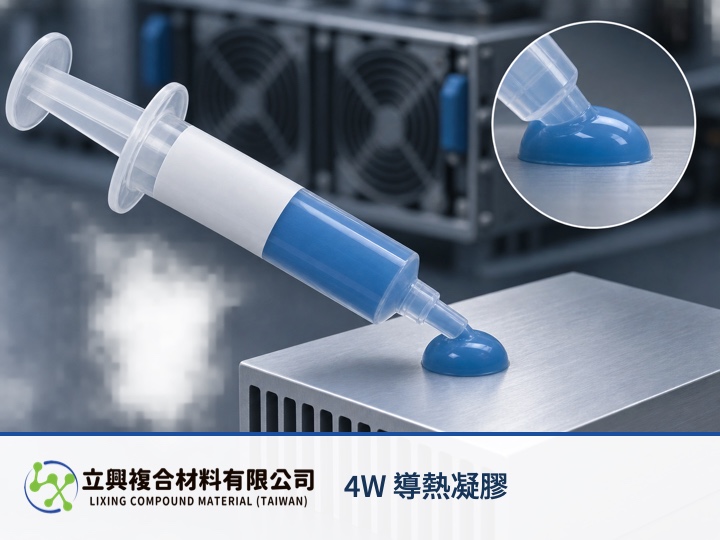
Data-center servers and automotive ECUs can address thermal-interface pump-out risk by validating oil separation, volatility, and the dispensed shape through temperature cycling. 4W Thermal Gel is a blue, single-component material rated at 4.0 ± 0.2 W/m·K on the product page, intended for automated dispensing into small gaps around high-power electronics.
Low oil separation supports traceable cycling checks
The product page lists oil separation at ≤ 0.01% and volatile content at ≤ 0.8%. These values provide a starting point for interface validation. Engineers still need to monitor displacement, voids, and thermal resistance under the actual clamping and temperature-cycle conditions rather than infer service life from catalog values.
High viscosity helps control the deposited shape
The listed viscosity is 6,500,000 ± 5% mPa·s, and the material is described as non-slumping and designed for automated dispensing. This supports repeatable placement before assembly-level coverage is verified. The official product page also lists an operating range of -30 to 180°C; that material range is not evidence that a specific device has passed the same cycling profile.
4.0 W/m·K supports a filled thermal path
The blue gel is intended to conform to rough surfaces between a heat source and a cooling module. Thermal design must still measure bondline thickness, contact pressure, and assembly thermal resistance, because material conductivity alone does not define module performance.
Use viscoelastic modulus to frame pump-out
Published TIM guidance expresses the complex shear modulus as G* = sqrt(G'^2 + G''^2), where G*, storage modulus G', and loss modulus G'' are measured in Pa. It combines elastic energy storage with viscous dissipation for oscillatory-shear data collected at stated temperature and frequency within the linear viscoelastic region. The technical reference discusses temperature cycling and TIM pump-out. The equation cannot predict this product's life, and the product page supplies no G' or G'' values.
Validate samples in the real assembly
Server and automotive engineers can record dispense volume, bondline thickness, clamping method, temperature limits, and post-cycle thermal resistance, then inspect for material movement or voids. For specifications and sample conditions, contact Lixing Composite Materials Co., Ltd. through the product page.