
Custom Shaped Silicone Tube Grades: Define Flame, Insulation, Antistatic or Thermal Needs
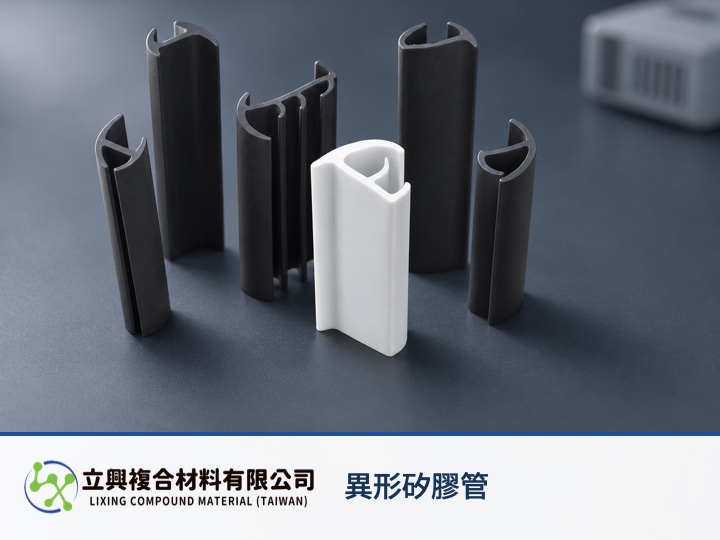
Electronics, appliance, and kitchenware seals that also need flame-retardant, insulating, antistatic, or thermally conductive behavior can combine a custom profile and a functional formulation in one sampling request. Engineers and buyers should first define the risk, contact environment, and verification method. Lixing's product page confirms that round, square, rectangular, and complex hollow profiles can be made from customer drawings.
Define the function before choosing a grade
Each function answers a different engineering question. Flame-retardant requests need a named test method and specimen thickness. Insulation requests need working voltage, contact position, and environment. Antistatic requests need a target resistance range and measurement conditions. Thermal requests need the heat source, contact surface, and allowable assembly pressure. The product page confirms that these functions are available as options, but it does not publish guaranteed values for each grade, so the target and test method belong in the request.
Profile geometry remains the basis of sealing and protection. The product can be customized to complex or hollow profiles; the official page lists a typical hardness range of 30–80 Shore A and a temperature range of -45°C to 200°C. These values help form an initial candidate, while dimensional tolerances, compression, and functional results still require drawing and sample review. See the Custom Shaped Silicone Tube product page for available forms and options.
Why antistatic formulations require sample data
Near the critical region, conductive composites can be described by the percolation power law: σ = σ0(φ − φc)^t, for φ > φc. Here, σ is composite conductivity, φ is conductive-filler volume fraction, φc is the critical percolation fraction, and t is the critical exponent. A peer-reviewed study explains that conductivity can change nonlinearly as connected paths form above the threshold.
This model only explains why an antistatic or conductive grade cannot be judged from a filler label. It does not predict this product's electrical performance and does not apply to flame-retardant, insulating, or thermally conductive grades. Filler geometry, dispersion, processing, and measurement conditions affect results. A sample request should therefore state the target resistance range, test method, temperature, humidity, and specimen dimensions.
Put the drawing and validation inputs in one request
An actionable request should include the profile drawing, critical dimensions, color, hardness range, curing method, service temperature, and functional target. For a door seal, enclosure, or protective profile, also describe contact media, bend path, and assembly. The product page lists platinum-cured and peroxide-cured options; the suitable route still depends on the application conditions.
Evaluating formulation and geometry together helps electronics, appliance, and kitchenware teams turn a custom sealing need into a verifiable sample. After preparing the drawing and test conditions, use the Custom Shaped Silicone Tube specification page to request a sample or discuss requirements.