
50 μm Transparent PET Tape Keeps Alignment Visible in Lamination
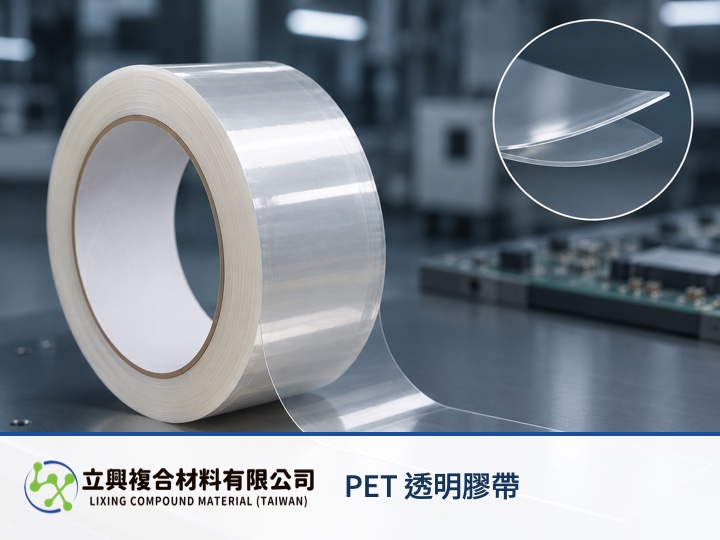
When electronics assembly needs visible registration without building up the protected interface, Transparent PET Tape provides a clear, 50 ± 2 μm profile. The product page also lists 180°C heat resistance and no adhesive failure during fast or slow peel tests, so alignment, process protection and removal can be reviewed together.
Does a 50 μm profile make the tape easier to place along an edge?
Its low geometric thickness supports laydown on flat component surfaces, while the transparent backing keeps registration marks visible. The verified construction is a 0.038 mm PET backing plus a 0.012 mm adhesive layer for a total thickness of 50 ± 2 μm; corners and curves still require trials at the actual tension and radius.
Can lamination protection be selected from the 180°C figure alone?
No single temperature figure covers every process. The official inspection data lists 180°C heat resistance, but dwell time, pressure and the bonded surface must also be supplied for selection. The figure is not presented here as a lifetime rating.
Will the clear film hold a component during initial placement?
The product page reports Ball No. 18 for initial tack, which supports immediate positioning as a verified selection input. Its clear PET backing also helps operators see the placement boundary; holding performance over time and the removal cycle still need confirmation on the actual assembly.
Can the thin tape reduce cleanup after removal?
The product page records no adhesive failure in both fast and slow peel adhesion tests and describes residue-free removal. This suits lamination protection and quality packaging where a clean surface matters, subject to trials for surface energy, contamination, ageing time and process temperature.
How does plate theory frame the effect of thickness?
The MIT plate model gives D = E h^3 / [12(1 - ν^2)], where D is bending rigidity, E is Young's modulus, h is thickness and ν is Poisson's ratio. For a homogeneous, isotropic, linearly elastic plate under small deflection, rigidity varies with the cube of thickness. This explains the geometric role of a thin backing, while PET and pressure-sensitive adhesive remain a viscoelastic composite that requires application trials. See the MIT course reference.
Should the process use PET or PI gold-finger tape?
Start with PET when the decision calls for visible alignment, a 50 μm profile and the 180°C condition stated on this product page. Review a PI product separately when the process requires different electrical insulation or higher-temperature conditions. A sample request should include temperature and dwell, target surface, width, bend radius, peel timing and residue criteria.
Electronics assembly and lamination teams that need a thin, transparent and clean-removing option can review the verified Transparent PET Tape data and request samples. The 50 ± 2 μm thickness, 180°C condition and Ball No. 18 tack come from the product page; production acceptance still depends on the actual workpiece.