
Thermal Gap Pad Thickness: Absorb Stack-Up Variation Better Than a Fixed Spacer
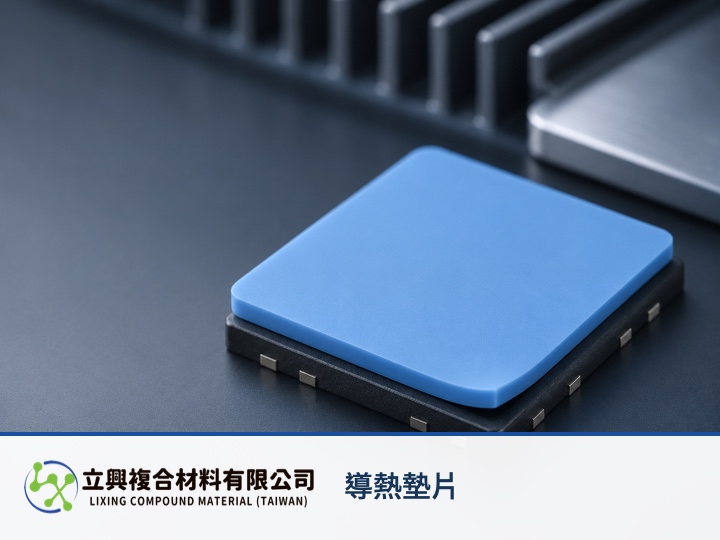
A fixed spacer follows one nominal dimension, while the gap between a heat source and metal cooling module moves with housing, component and assembly variation. A thermal gap pad is available in 0.25 mm to 1.3 mm thicknesses and 5 to 40 Shore B hardness, giving CPU, GPU and metal heat-sink assemblies a compressible interface at low pressure. Selection starts with the real gap distribution, then checks whether pad thickness and acceptable compression cover it.
A fixed spacer follows nominal size; a gap pad follows the assembly
A rigid or fixed-thickness alternative has limited room to absorb both ends of a tolerance range. The verified softness and compressibility of this silicone pad help it conform to uneven surfaces and fill air gaps. The published hardness range is 5 to 40 Shore B, while allowable compression must still be verified against assembly pressure and component load limits.
Conductivity alone misses the effect of path length
Another common approach selects the material by thermal conductivity and then uses whichever thickness is convenient to source. Lixing offers grades from 1.0 to 10.0 W/m·K, but the same k value must be read with actual thickness and interface contact. A thicker pad can bridge a larger mechanical gap while also lengthening the heat path, so a sample comparison should hold grade, thickness and compression conditions together.
Representative gap measurements beat one drawing dimension
One nominal drawing value does not describe the combined movement of housing flatness, component height and heat-sink position. Measure representative locations and preserve the low, middle and high gap values before comparing them with the available thermal pad range. A statistical estimate supports the decision; it does not guarantee every assembly.
Estimate random stack-up by RSS, then protect the boundary by worst case
NIST combines independent uncertainty components by root-sum-of-squares: u_c = sqrt(u_1^2 + u_2^2 + ... + u_n^2). Here, u_c is combined standard uncertainty, u_i is each dimensional source in a common unit such as mm, and n is the number of sources. This engineering model is suitable for approximately independent random contributors. Correlated inputs, systematic offsets, unknown distributions or guaranteed interchangeability still require worst-case analysis and physical fit validation. See the NIST/SEMATECH e-Handbook.
Custom die cutting turns a generic sheet into a defined interface
Generic sheet stock is often cut at the point of use, separating thickness, outline and placement into different decisions. Lixing can adjust size, shape and tack, with precision die-cut or roll supply. That capability helps thermal modules, power supplies and automotive power components translate a known gap location into sample conditions. The product page also lists -40°C to 200°C and UL 94 V-0 / V-1 grades; buyers should confirm the selected grade and test conditions.
Send the dimension chain with the sample request
Useful sample inputs include nominal gap, individual tolerances, measured distribution, contact area, allowable pressure, operating temperature and thermal requirement. The thermal gap pad product page defines the available thickness, hardness and conductivity ranges. Final selection depends on the chosen grade and validation in the actual assembly.
Keep tolerance inside the selection decision
CPU, GPU and metal cooling modules need a repeatable contact window. Inputs for flexible thermal pad selection should keep thickness, tolerance and pressure together so the interface can absorb reasonable gap variation. A sample request built around the dimension chain gives engineering and industrial purchasing teams a stronger basis than one nominal thickness.