
Overcoming Interfacial Cavities:
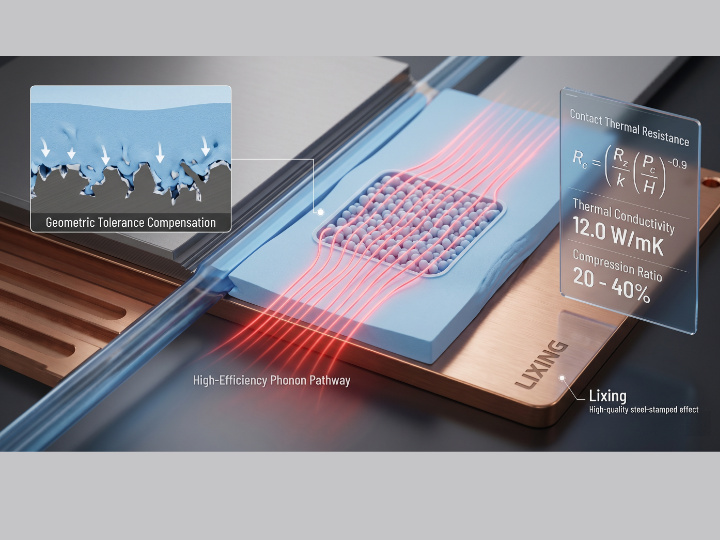
In high-power-density electronics packaging, microscopic air gaps between components and heatsinks severely hinder thermal transport. The primary function of a Thermal Pad is to eliminate these insulating micro-air pockets through controlled compression and interfacial polymer creep, successfully compensating for geometric tolerances.
Material Science: Macroscopic Compliance & Contact Resistance Models
Microscopic Interfacial Thermal Resistance (Rc): According to Mikic's elastic contact theory, the interfacial thermal resistance Rc is highly dependent on surface topography and pressure, modeled as: Rc = (R_z / k) * (P_c / H)^(-0.9) (Pure text: Rc = (R_z / k) * (P_c / H)^(-0.9), where R_z is surface roughness, k is pad thermal conductivity, P_c is contact pressure, and H is material micro-hardness) Lixing pads lower the matrix hardness (H) to drastically reduce Rc under minimal loading.
Phonon Conduction at High Filler Loading: By creating a dense, random close-packing network of ceramic fillers (Al2O3/BN), the pad enhances lattice-vibration phonon transport. The thermal flux Q follows Fourier's Law: Q = k * A * (dT / d) (Pure text: Q = k * A * (dT / d), where d is the compressed thickness of the pad)
Shear Stress Minimization: Highly loaded pads can become rigid, risking die cracking during assembly. Lixing's unique low-molecular-weight network allows exceptional 2D interfacial creep under Z-axis pressure, dissipating internal shear stress.
Industrial Applications
Server Processors & Cold Plates: Compensating for warpage and micro-tolerances in high-TDP hardware.
High-Density Power Supply Modules: Providing reliable thermal interface with zero mechanical distortion to sensitive inductors.